 |
Engineer
|
|
Bridges
Item #5: Make drawings of three
kinds of bridges.
Explain them.
Ahead of time gather the materials to build and demonstrate bridges.
Bricks work well as ends. Get some stiff card stock, construction paper, cardboard,
and craft sticks. Make the bridges as shown in the Webelos handbook. Make the
square and triangle sections as shown in the handbook.
You cross over or under bridges every day. If you travel on the freeway you
go under and over them all the time. Look for bridges during the week. How many
types of bridges can you identify?
BRIDGE BUILDING
Ever since man found roads that would let him travel from one place
to another easier and faster, he has been faced with the problem of crossing
streams, rivers, gullies and canyons. So he invented bridges - structures
to leap from these obstructions and make the way smoother. At first, he used
two basic geometric forms to build these structures - the arch and the triangle
- and built his bridges of stone and wood. Today, highway and railroad bridges
are made from steel plates, wire cable, angles, I-beams, H-beams and concrete
to build the bridges we see crossing interstate highways, rivers and canyons.
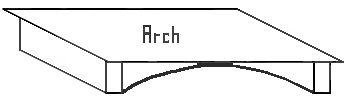
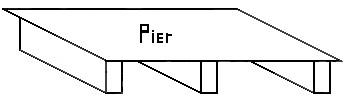
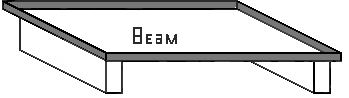
Don't just draw bridges, build them! A drawing cannot demonstrate
the structure, strengths and weakness of the various bridge types. To build
bridges, use construction paper or poster board strips (cut all road bed strips
the same size, so the boys will not say a bridge is stronger because the strip
is wider, etc.) Use building blocks of 2x4's, bricks, or what ever, for supports.
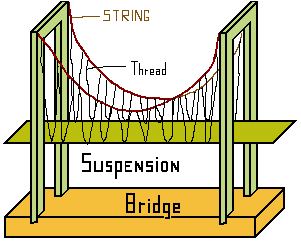
Tape to table top with masking tape or thumbtack to 2x4's. Use toothpicks
and thread for suspension bridge.
Using small cars, keep piling them on the bridges until the bridges
collapse. The boys love to try to bring about the demise of the bridges and
are astounded at the strength of the truss and suspension bridges.
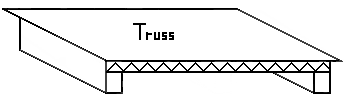
The design of a bridge and the type of construction depend upon
the kind and width of the obstruction, the load it is expected to carry, the
kind of ground or rock found at the site and the cost. To learn about bridges
and their construction, here are four different types you can make from cardboard.
They can be used to display matchbox size of HO cars.
WOOD TRUSS BRIDGE - This bridge is 2" wide, 4" long with
sides 1" high. Lay out the sides and bridge floor as one piece, then cut halfway
through the cardboard where the parts join and fold up the sides. Each side
on a full-sized bridge would be built up with four timbers and iron rods,
so draw the joints of the timbers with a pencil. Glue up six layers of cardboard
1/2" x 2-3/4" for abutments at each end of the bridge. This type of bridge
was used in colonial days for single-lane roads. Some still exist today.
STONE ARCH BRIDGE - This bridge is made from three pieces of cardboard.
Sides are 1" high and 4" long. The arch is 1/2" x 1-3/4". The floor and ends
are made as one piece, then scored and bent. The floor is 3-7/8" long. Each
end is 1/2" long and 1-1/2" wide. Draw the outlines of stones with a pencil.
THROUGH PLATE GIRDER BRIDGE - This is typical of the reinforced steel-plate
bridges we see used for both roads and railroads today. It is 3" wide and
9" long. The bridge floor and sides are laid out as one piece - the floor
is 3" wide and 9" long the sides are 1" high. Vertical lines are spaced on
one-inch centers. The steel angles used to reinforce the steel plates are
simulated by pencil lines. Abutments are made from six layers of cardboard
5/8" x 4" glued together. Pencil dots for rivets and pencil shading along
the sides give the bridge a 3-dimensional effect.
MODERN STEEL ARCH BRIDGE - Made from three pieces of cardboard. The
deck is 3" wide and 20" long. Side's (or railings) are 1/2" high. Make the
sides and deck as one piece, then score and bend. Lay out one side and one
end for the bottom 2' x 4". Arch opening is 11" long by 3" high. Lay out vertical
steel beams on 1" centers and mark them with a black felt tip pen. Steel arch
bridges are used by railways and highways to span deep canyons. If the canyon
is rock, no concrete abutments are needed.
MODEL MONKEY BRIDGE
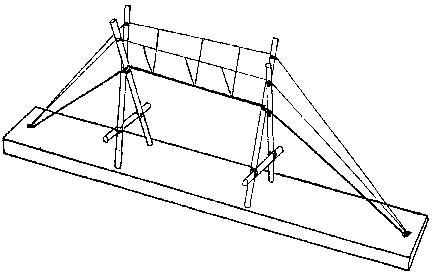
Based on a foot bridge found in the high mountains of India, the monkey bridge
uses one thick rope to walk on and two others as hand ropes. Ali the same knots
and the same design are used in this model as are found in the full-sized version.
The monkey bridge is often built in Scout camp as part of the Pioneering merit
badge.
You'll need some hemp cord, some pieces of strong string, four l/4" dowels 10"
long, and two 1/4" dowels 4" long. A piece of scrap lumber at least 30" long
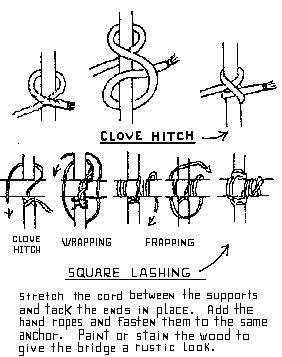
and 4' wide makes a good base. Make the shear lashings first, about 4" from
the top of the shear legs. Tie loosely so the legs can open. Add the crosspieces,
fastened with square lashings about 2" From the bottom. All lashings begin and
end with a clove hitch.
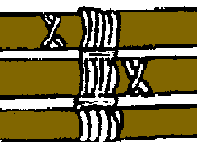
Ask you Den Chief or call a Troop to provide a Boy Scout for help
with the lashings.
Return to
Engineer Activity Pin ~
Webelos Activity Pins ~
Opening Webelos Page